

How Supportive Girl Dads Handle Playground Drama
Navigating Back to School Playground Drama Like a Pro
Ever wonder how to turn back-to-school playground squabbles into life lessons? I’ve got it covered.
I write for Modern Dads to share what I’ve learned while raising my daughter amidst daily playground chaos.
When tensions flare, I calmly remind her, “You’ve got this!” and show her how to practice empathy.
Last week, she faced a classic dispute over swing time. I encouraged her to talk it out, helping her see both sides.
Who knew a little patience could turn a tantrum into teamwork?
A few days ago, she came home beaming after resolving a conflict with a friend. They ended up collaborating on a school project! I couldn’t resist saying, “That’s more than just playground politics – it’s diplomacy!”
Quick Takeaways
- Model calm and empathetic responses to help girls learn healthy conflict resolution.
- Use open-ended questions to encourage self-awareness and reflection on playground disagreements.
- Support emotional regulation by teaching deep breathing and calming techniques during conflicts.
- Promote positive social skills through role-playing and reinforcing supportive communication.
- Create a safe environment where girls feel comfortable sharing feelings and seeking advice.
How Playground Drama Affects Your Daughter’s Confidence
Ever notice how a single playground tattling or eye-roll can turn into a mini-drama that sticks with your daughter all afternoon? That’s the power of peer pressure and its sneaky effect on her self-esteem. When she feels judged or left out, her confidence takes a hit, making her doubt her worth.
I recall Liam coming home upset after a playground squabble—he looked tiny in that moment. This is where we, as dads, step in. We can help her see that her value isn’t based on others’ approval.
Encourage her to:
- Stand firm against peer pressure
- Recognize her strengths
- Own her feelings and choices
Because confident girls rule playgrounds and life!
Model Positive Conflict Resolution as a Supportive Dad
Let’s face it—no parent wants to see their kid blow up over a playground squabble, but the real magic happens when we, as dads, model how to handle conflict with grace. When kids see us practicing emotion regulation, they learn to stay cool and think instead of lash out.
Ever noticed how peer empathy can change everything? I remember Liam calming down after I gently pointed out how his friend might’ve felt. Just like creative activities can bring families together, managing playground conflicts builds stronger bonds between kids and parents. Building hands-on electronics projects together can also help channel energy constructively after resolving conflicts.
To do this:
- Stay calm, breathe deeply—show that’s how adults handle tough situations.
- Listen actively—what’s really bothering your kid or peer?
- Respond with understanding, not anger.
- Encourage your kid to see the other side—empathy is powerful!
Model this, and your daughter will learn to navigate conflicts not with fighting but with strength and compassion.
Spot the Signs Your Daughter Needs Help With Playground Conflicts
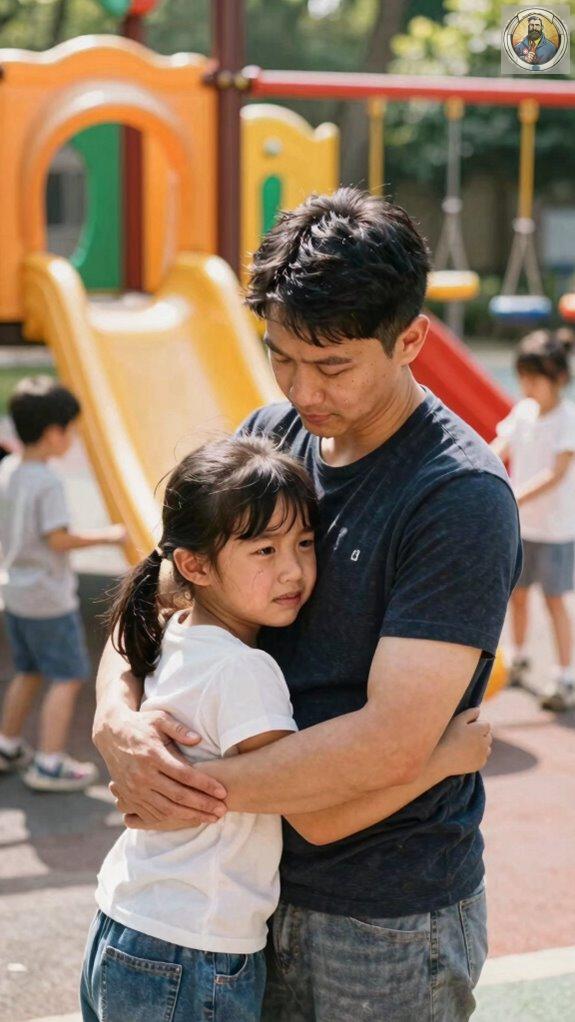
Recognizing when your daughter is struggling with playground conflicts is like being a detective on a mission—you need to pay close attention to the clues. Emotional cues are your first hint: if she suddenly clams up, avoids eye contact, or seems anxious, she might be upset.
Peer recognition matters too—if she’s crashing out of a game, dismissing others, or seeking constant approval, she’s signaling trouble. Remember when Emily used to get quiet after school, or Liam would come home upset? That’s your cue to ask questions. Teaching her conflict resolution skills through structured activities can help her navigate these challenging social situations more effectively.
Be proactive: watch her body language, listen carefully, and don’t dismiss small signs. Sometimes, kids hide distress so well you’d miss it—don’t let that happen. Creating safe spaces like indoor tent building projects can also help children feel more comfortable opening up about what’s bothering them. Your attentiveness could be the key to turning playground drama into a teaching moment.
Practical Tips to Boost Your Daughter’s Social Confidence
Building your daughter’s social confidence might sound like a tall order, but trust me, it’s all about tiny, intentional steps that add up over time. Want her to handle playground drama with poise? Here’s how:
Helping your daughter build social confidence involves small, deliberate steps that grow over time.
- Teach Emotion Regulation — Show her calming tricks like deep breaths or counting to ten when she feels overwhelmed. If she learns to manage her feelings, she’ll project confidence and learn to read peer perception better.
- Boost Peer Perception — Encourage her to observe other kids’ reactions. Ask questions like, “How do you think she felt?” or “What would you do differently?” Reinforce that her voice matters. Understanding how children navigate social hierarchies can help her recognize unhealthy relationship dynamics early on, including recognizing toxic peer pressure that may emerge as she grows older.
- Practice Positive Self-Talk — Remind her she’s strong and capable. Share how you motivate yourself when facing tough situations. Power is often about mindset.
- Support Emotional Growth — Understanding emotional growth development will help you recognize when she needs extra support navigating social challenges at school, allowing you to guide her through conflicts with greater insight into her developmental needs.
How to Have Open Conversations About Playground Disagreements

When your daughter comes home rattled after a disagreement, it’s tempting to jump in and fix everything — believe me, I’ve been there. But, instead of rushing to solve her problem, try having an open conversation about playground disputes. Ask her what happened and listen — really listen.
Explain how bullying prevention isn’t about quick fixes, but about understanding peer pressure and feelings. Research shows that addressing incidents promptly helps prevent escalation and models constructive conflict resolution for young people. Share a story about Liam, who once faced similar drama and learned to stand up confidently.
Encourage her to speak openly about her feelings, ask questions like, “What would you do differently next time?” and remind her she’s in control of her reactions.
Recall, empowering her to navigate disagreements helps her grow into a strong, resilient girl who makes her own choices.
Fun Activities to Build Empathy and Resilience in Your Daughter
Ever notice how some of the most memorable moments with kids are the ones that turn into fun learning adventures? Building empathy and resilience can be a game-changer, especially when tackling sibling rivalry and peer comparison.
Here’s how to turn everyday activities into power-packed lessons:
- Role-Playing Games – Act out playground scenarios with your daughter, emphasizing understanding others’ feelings. This boosts empathy and helps her navigate sibling rivalry more wisely. Research shows that perspective-taking exercises in role-playing games significantly reduce bullying behavior among peers.
- Kindness Challenges – Set daily goals like complimenting a peer or helping a sibling. It encourages resilience and diffuses any comparison games.
- Storytelling Time – Read stories where characters overcome challenges, then discuss what they learned. This enhances emotional strength and awareness. Pairing these stories with tactile exploration activities can further deepen your daughter’s sensory awareness and emotional connection to the lessons.
Think of these activities as tools for cultivating fierce, emotionally intelligent girls ready to handle any playground drama.
Sharing Favorite Playground Slide
| Do | Don’t | Extra Tips |
|---|---|---|
| Share with enthusiasm | Hoard it selfishly | Praise patience openly |
| Offer comfort after spills | Yell if she hesitates | Make turns fun & fair |
| Encourage her to wait patiently | Ignore her feelings | Lead by example |
Sharing makes us strong—and in the playground, that’s a true power move. Consider incorporating martial arts games into your family fitness routine to build confidence and respect for others alongside traditional playground activities. You can also explore creative paper crafts as quieter bonding activities that teach cooperation and turn-taking in a different setting.
New Friendships Forming
Have you ever watched kids at recess suddenly latch onto new friends like they’ve known each other forever? It’s like the playground turns into a friendship factory overnight!
Here’s how you can power up those moments:
- Friendship nurturing: Encourage your kid to be inclusive—invite others to play or share toys. It builds confidence and likeability.
- Sharpen social skills: Teach them simple phrases like “Want to join us?” or “Good game!” These open doors to new connections fast.
- Lead by example: Show your kid how to listen and cheer others on—kids watch and emulate. Being a supportive cheerleader helps cement those bonds.
Just like batch cooking breakfasts makes weekday mornings easier, establishing solid friendship foundations early sets your child up for social success throughout the week. Consider incorporating family game nights into your routine to further strengthen these social bonds in a relaxed home environment.
Back to School Essentials
When I think about back-to-school time, it’s like gearing up for a mini adventure—and the right essentials can make all the difference. Power-packed school supplies aren’t just about filling a backpack; they’re about setting your kid up for success. Think durable notebooks, clever pencils, and a sturdy backpack that’s ready for anything. Establishing back-to-school routines helps your child feel confident, organized, and ready to conquer the day. Keep in mind, it’s not just about the stuff—they need your support and guidance to create smooth mornings and confident attitudes. Consider investing in mesh sports ball bags if your child participates in youth sports, as they’re an affordable and durable option for organizing gear. You might also explore indoor challenge courses to build your child’s confidence and physical skills during after-school hours. Here’s a quick look:
| School Supplies | Back to School Routines | Power Tools for Success |
|---|---|---|
| Durable folders, water bottles | Packed the night before | Inspirational notes in lunch |
| Pencils, erasers, ruler | Regular bedtimes | Visual schedules |
| Backpack that fits | Morning checklist | Positive reinforcement |
| Lunchbox | Consistent wake-up time | Encouragement notes |
| Art supplies | Organized homework area | Confidence boosters |
FAQ
How Can I Teach My Daughter to Set Healthy Boundaries?
Wanna teach your daughter to set healthy boundaries? It’s all about empowering her voice, just like I learned with Emily.
Start by discussing cultural differences and family traditions—help her see that her feelings matter.
Show her examples: “If someone crosses a line, say ‘No thanks,’ firmly.” Practice role-playing, praise her courage, and remind her that respecting herself gains respect from others.
Boundaries aren’t walls—they’re shields!
What Should I Avoid Saying During Playground Conflicts?
You should never say things like “Stop being such a crybaby,” or personal insults during playground conflicts. These words only escalate drama and tear down confidence.
Instead, focus on calming words, like “Let’s talk this out,” or “How can we solve this?”
Keep in mind, sarcasm or harsh comments shut down communication.
I’ve seen my daughter Emily blossom when I stayed positive, even when Liam’s teasing tried to get under my skin!
How Do I Handle When My Daughter Feels Embarrassed?
When your daughter feels embarrassed, my advice is to stay calm and show her you understand.
Remind her that peer approval isn’t everything and that sibling rivalry doesn’t define her. I’ve seen this work with Emily after a teasing incident; I hugged her and told her she’s amazing.
Encourage her to talk, boost her confidence, and teach her to brush off playground drama—because little victories build big confidence!
When Is It Necessary to Intervene in Her Playground Disputes?
Whenever friendship conflicts or sharing disputes threaten her confidence, I step in.
For example, if Emily starts crying over a toy, I calmly suggest she talk to her friend or take a breather.
If disputes escalate—say, someone grabs her property or the girl is visibly upset—I intervene firmly, guiding her to articulate her feelings or find a solution.
Keep in mind, support is key—know when to empower her and when to step up.
How Can I Encourage Her to Stand up for Herself Confidently?
Encourage her to stand up confidently by empowering independence and building resilience. Ask yourself: Am I giving her the tools to succeed?
I tell Emily to practice phrases like, “No, I don’t like that,” or “Please stop,” and praise her when she tries. Remind her that staying calm shows strength.
It’s like lifting weights—small reps lead to big confidence. She’s got this. You just need to cheer her on!


