

7 Essential Compass Lessons for Modern Dads
Mapping Life Lessons: Navigating Fatherhood One Compass at a Time
I learned the hard way that nothing beats old-school tools. My $20 Suunto M-3 compass? It taught my son more than any tablet could.
Always point that red needle north—like a dad’s moral compass. Hold it flat, not like the sideways bike he insists on riding.
We practiced taking bearings on fire hydrants and even Sarah’s garden gnome—lots of giggles, but we got it right. I paired it with a simple backyard map; easy and bright. Moss? Totally unreliable. Emily finally stopped asking, “Are we lost?”
One Saturday, we stood in our backyard, looking at our map. I watched my kid’s eyes widen as he figured out that we could navigate through our neighborhood with just a compass and a little imagination.
We set out on a “treasure hunt,” using our newfound skills. The ultimate prize? A half-eaten granola bar he “found” under the swing set. Laughter rang through our home, turning a simple compass lesson into a day of adventure and memories.
Being a dad today means creating moments that matter, even when they involve a buckled granola bar!
Quick Takeaways
- Teach kids to use a compass early with simple, durable models like Suunto or Silva for reliable, hands-on learning.
- Hold the compass flat to ensure the magnetized needle aligns accurately with Earth’s magnetic field.
- Practice bearings using nearby landmarks to build navigation skills in a fun, engaging way.
- Combine compass use with basic hand-drawn maps to reinforce map-reading and orientation for beginners.
- Use outdoor activities like geocaching to make learning navigation interactive and memorable for the whole family.
Start With the Basics: How a Compass Works
Ever wonder why your GPS goes full drama queen the second you lose signal in the woods?
Poof. Gone. No backup dance.
Poof. Gone. No backup dance—your GPS ghosts you when the trees close in.
Digital navigation? Great—until it’s not. That’s where your trusty compass struts in like a silent superhero.
I learned this when Liam yelled, “Dad, we’re lost!” (Spoiler: We weren’t. Thanks, compass.)
A compass? Just a magnetized needle playing follow-the-leader with Earth’s magnetic field.
No batteries. No updates. Just *point north*.
Outdoor survival 101: Know how it works *before* you’re snack-stealing squirrels deep in the wild.
Hold it flat. Check the needle. Stay calm.
For longer outdoor adventures with kids, consider bringing portable white noise machines to help them sleep better in unfamiliar camping environments.
You’ve got this.
Always Point the Red Needle to North
That’s when you recall: the real map isn’t in your pocket.
It’s in your hand — that tiny compass, defying chaos since compass history began with wobbly Chinese needles.
Always point the red needle to north. It’s not a suggestion — it’s magnetic principles, baby!
Forget it, and you’re hiking toward “mystery snack” territory with Liam.
Do it right, and you’re Captain Amazing Dad, not “the guy who got lost near the 7-Eleven.”
Sarah still brings that up.
Turn the compass bezel until north aligns.
Seriously — even Emily (age 6) nails this.
Just like knowing when to use safe tick removal tools on the trail, mastering your compass prevents more than just wrong turns.
You got this.
Stay oriented.
Hold the Compass Flat for Accurate Readings
Because gravity’s not your GPS, holding your compass flat isn’t just a suggestion — it’s how you avoid leading your crew straight into the “Why is this lake where the gas station should be?” zone.
Tilt it? The needle drags. Accuracy dies. You’re lost faster than Liam’s socks in the dryer.
Keep it level — like a tray of Jell-O at a picnic.
- Prevents magnetic interference from skewing readings
- Guarantees proper compass calibration every time
- Makes you look like you know what you’re doing (even if you don’t)
Sarah still laughs about my “mountain man moment” last hike.
Pairing a quality compass with durable flashlight options ensures you can navigate confidently in low-light conditions during outdoor adventures with the kids.
Flat compass = fewer wrong turns.
And fewer reasons for Emily to say, “Dad, even mywatch has GPS.”
Trust me, pride’s heavier than a map.
Practice Bearings Using Nearby Landmarks
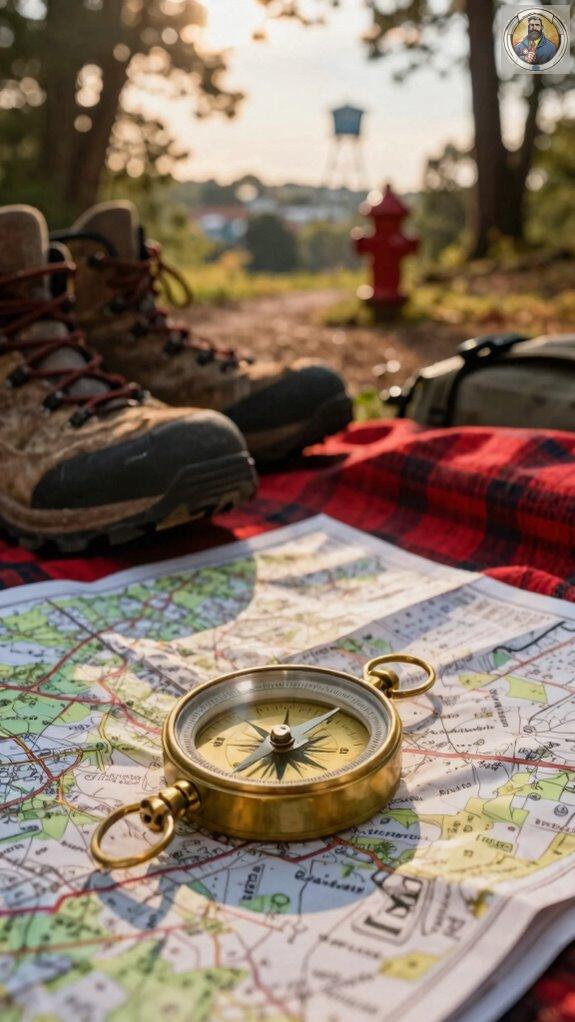
Spoiler: the oak was in the opposite direction.
I thought I nailed landmark recognition—until I led my family *away* from the park’s giant oak. Fun.
Now I practice bearings using nearby stuff: fire hydrants, water towers, that suspicious van down the street.
- Pick a landmark.
- Use compass to get its bearing.
- Cross-check with terrain estimation (yes, that hill matters).
Sarah says I’m obsessed. Liam’s more concerned I’ll “accidentally navigate us to Canada.”
It’s not magic—just science, sarcasm, and not trusting trees.
Want real stakes? Try reading a compass while Emily judges your life choices.
Practice helps. A lot.
Keep a portable fire extinguisher at camp in case your navigation mishaps accidentally start something on fire.
You’ve got this. Probably.
Turn the Dial to Follow Your Direction
One tiny twist of the compass dial changed everything — and almost got us stranded at the edge of a cornfield during last summer’s camping trip.
One twist of the compass dial sent us wandering into a cornfield maze—lost, laughing, and lesson learned.
You think Dad knows best? Not when he ignores navigation safety.
I spun the dial like a game show wheel—oops. North became “mystery direction.”
Always align the dial with your bearing. Check it twice.
Compass maintenance matters: keep it level, away from metal (yes, even your belt buckle, Liam).
No cracks, no bubbles—mine survived three kids and Sarah’s “organized chaos.”
Just like choosing breathable rain jackets for active outdoor adventures, proper gear maintenance ensures your family stays protected and comfortable on every expedition.
Want horror stories? Ask Modern Dads.
Turn the dial with purpose.
Not guesswork.
You’re not lost yet.
Turn Learning Into Play With Scavenger Hunts
When we turned the map upside down last fall and called it a “shortcut,” Emily rolled her eyes so hard I thought they’d get stuck.
Now we turn every hike into a treasure hunt. Geocaching adventures? Total game-changer.
Grab a free app—like Geocaching®—hide tiny prizes, and let the kids navigate.
It’s outdoor survival training disguised as play.
“Dad, are we lost?” Sure, Liam. That’s the point.
Use rhymes: “North is cold, face the pole!”
Add silly stakes—loser carries everyone’s snacks.
Suddenly, compass skills stick.
Who knew “find the plastic snake near the crooked pine” taught bearings better than lectures?
Learning’s not a chore.
It’s a mission.
Pack the right kids daypack size so they can carry their own maps and gear on longer adventures.
And honestly? I’m just cheating so they don’t notice they’re becoming wilderness ninjas.
Modern Dads win.
Pair the Compass With a Simple Map First
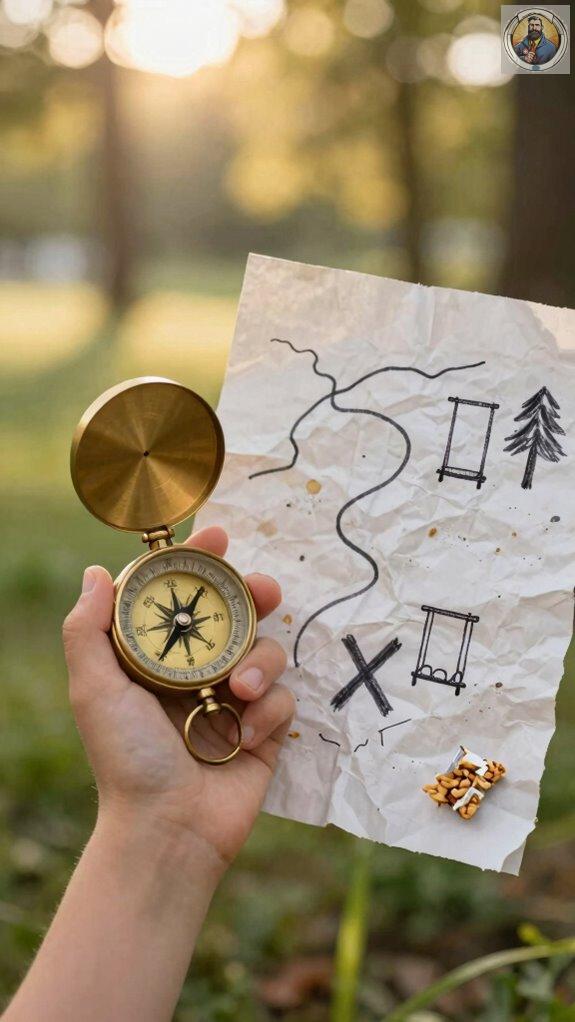
If you think handing a kid a compass alone is like giving them a puzzle without the picture on the box — congrats, you’re already halfway to getting it.
Pair that compass with a simple hand-drawn map of the backyard. Seriously, even stick figures work.
Pair the compass with a backyard map sketched on scrap paper—stick figures, wobbly trees, maybe a lopsided swing set. It’s not art. It’s adventure.
I once tried “technology integration” with Liam using a tablet — total disaster. He zoomed out, spun the map, and “found” Narnia.
Start basic:
- Sketch trees, the swing set, Sarah’s prized roses (avoid those).
- Mark “X” where snacks wait.
Safety precautions? Yes — like not eating suspicious berries.
“Which way to the treasure?” Try it. They’ll forget their iPad exists.
Success tastes like slightly squished granola bars.
Get Compass Tools for Beginners
You handed them the compass, you drew the lopsided backyard map with the stick-figure dog guarding the snack stash — and boom, they actually used it.
Now, let’s talk gear. Skip the antique brass thing Grandpa swore was “magic.” That’s a *decoration*, not a tool. Beginner compasses? Grab a Suunto M-3 or Silva Starter.
They’re cheap, tough, and ignore most magnetic interference—like the fridge your kid insists is “haunted.”
For young explorers just starting out, top kids’ compasses designed for beginners offer the durability and ease of use that make learning navigation enjoyable rather than frustrating.
Forget compass myths: you don’t need calculus or eagle eyes. Just a baseplate, a needle, and common sense.
Keep it simple.
Keep it fun.
And maybe don’t let Liam near Mom’s iPad during treasure hunts. Trust me.
Teaching Map Navigation Together
Honestly? I once got us lost for 45 minutes because I believed the “north is always up” navigation myth. Spoiler: it’s not.
Got lost for 45 minutes chasing the “north is always up” myth. Spoiler: maps don’t care about your assumptions.
Teaching map navigation with your kid? Gold.
We busted myths while hiking with Emily and Liam. (Spoiler: moss *doesn’t* always grow on the north side.)
Start simple:
- Pick a park trail
- Match map landmarks to real trees, rocks, roads
Then level up. Try advanced techniques—like triangulation—near Sarah’s favorite picnic spot. A quality orienteering compass for kids makes these lessons much more effective and engaging for young learners.
Seriously, watching your kid “get it”?
Priceless.
Still laugh about the time Liam said, “Dad, the map’s upside down.”
Turns out… he was right.
Modern Dads love these messy wins.
You in?
Kid-Friendly Baseplate Compass
Why do some compasses look like they belong in a spy movie while others seem… well, actually usable for a 10-year-old?
Mine doesn’t shoot lasers. It’s a Suunto MC-2—at $40, it’s sturdy but not a paperweight.
For kid-friendly baseplate compasses, think: simple, durable, and *not* confusing.
We ditched the military-grade junk after Liam tried to “hack” it with a spoon.
- Clear baseplate? Check.
- Rotatable bezel? Yup.
- Bright colors? Bright enough Sarah mistook it for a toy.
When selecting a compass for children, baseplate compasses are ideal because they combine navigational accuracy with an intuitive design that young explorers can master quickly.
Adventurous exploration starts with gear kids can actually use.
Family bonding means not yelling, “NO, THAT’S NOT NORTH!”
Just sayin’.
Get one. Try it. Thank me later.
FAQ
Can I Use a Compass Indoors?
Compass calibration? Critical.
Keep it away from:
- Phones (seriously, Liam’s tablet ruined mine)
- Microwaves (Sarah laughed *so hard*)
- Steel beams (your house isn’t haunted—it’s just magnetically confused)
Trust me, the great indoors? Not exactly *outdoor* reliable.
Do Compasses Work the Same at Night?
Yeah, compasses work the same at night—darkness doesn’t freak out magnets.
Magnetic interference? That’s your real enemy. Not monsters. Not bad parenting vibes.
Keep it away from phones, speakers, or that haunted fridge Sarah swears is “off.”
Celestial navigation’s cool if you’re into constellations, but I just use my Suunto.
Once, Liam thought the compass spun because Emily cursed it. Nope. Just my keys.
Trust the needle. Not your kids’ drama.
What if My Compass Needle Wobbles a Lot?
Hold it steady—away from phones, keys, or that suspiciously shiny belt buckle.
I once panicked near a car. Turns out? My compass hated my wife’s new magnetic phone mount more than I hated assembling Emily’s trampoline.
Try calibration techniques:
- Rotate slowly in a “figure 8”
- Check accuracy away from metal
- Use a Suunto or Brunton for reliability
- Don’t trust Liam’s “magic” compass—it’s a toy with glitter.
Calibrate often. Or embrace confusion. Your call.
Can I Repair a Broken Compass Myself?
Yeah, I’ve tried DIY repair on a busted compass—spoiler: it didn’t end well. One minute I’m channeling my inner MacGyver, the next, I’m lost in the backyard *again*.
Compass maintenance? Sure, I clean the bezel and check for bubbles. But if the needle’s snapped or the housing’s cracked? Save yourself the “adventure” and just buy a new one.
Honestly.
No shame.
Even Modern Dads know when to quit.
Are Smartphone Compass Apps as Accurate?
I spin mine like a breakdancer. Twice.
Every few months.
Magnetic declination? Most apps handle it automatically—unlike my son Liam, who still forgets his shoes.
But Sarah’s iPhone? Still thinks north is toward the fridge.
Try it: Open the app, move in figure-eights.
Follow the on-screen prompts.
It works—mostly.
Would I trust it on a real wilderness trek?
Please. I’ve seen Tamagotchis with better reliability.


