

5 Campfire Safety Tips for Modern Outdoor Dads
Campfire Safety: Tips for the Modern Dad
Campfires can go from cozy to chaos faster than you can say “s’mores.”
I’m sharing a few safety tips based on my wild adventures as a dad on camping trips. Trust me, you don’t want to relive my near-miss with Liam’s flaming shoelace.
Pick your spot wisely—at least 10 feet from tents, trees, and Sarah’s “fireproof” book collection (spoiler: it’s not). Always keep a 5-gallon bucket and shovel nearby.
Never leave the fire unattended, not even for a sec. When it’s time to put it out, douse it, stir it like you’re making scrambled eggs, and use the back of your hand to check for heat. If it’s warm, it’s still a flame.
And for the love of marshmallows, grab an ABC-rated fire extinguisher. You won’t regret it.
This past summer, my kid and I had a fire-watching moment. He leaned in closer to watch the flames, then promptly tripped over a log! A reminder to always keep an eye on the little ones, especially around fire.
Dads, remember—fire safety first, fun second!
Quick Takeaways
- Choose an open, flat site at least 10 feet from tents, trees, and gear to prevent accidental fires.
- Always keep a full water bucket and shovel within reach for quick flame control and emergencies.
- Never leave a campfire unattended—assign a dedicated fire watcher at all times.
- Use rocks to contain flames and extinguish fires completely by dousing, stirring, and checking for heat.
- Teach fire safety early, involve kids in safe practices, and keep extinguishers and first-aid kits accessible.
Pick a Safe Spot for Your Campfire
Choosing a sheltered site isn’t just smart—it’s survival-level dad wisdom. Pick open space, at least 10 feet from tents, trees, or Liam’s “totally fireproof” Pokémon card collection.
Pick your spot like your dad would—open space, 10 feet from tents, trees, or questionable Pokémon collections. Safety isn’t optional.
And hey, unless you’re trying to roast marshmallows from 20 feet away, keep the flames manageable. That’s where Monitoring fire size comes in. Seriously, a campfire shouldn’t look like a dragon’s living room.
Use rocks to contain it. Start small—no need to impress anyone. If you’re bringing young children along, consider packing a lightweight hiking backpack so they can carry their own gear safely while staying close to the fire.
Ask yourself: Do I want cozy warmth or a visit from the forest rangers? Exactly. Be the hero who picks the smart spot.
Keep a Water Bucket and Shovel Ready
Look, I learned the “water bucket rule” the hard way—during Liam’s third attempt at “flaming banana skewers” (don’t ask). Now I never skip fire safety basics. Your campfire gear isn’t complete without two MVPs: a full bucket and a shovel. Seriously, they’re like the unsung bodyguards of backyard infernos.
- Always keep a 5-gallon bucket right next to the fire ring—no, not “over by the picnic table.”
- Fill it before lighting the fire—water doesn’t pour itself, genius.
- Use the shovel to smother flames fast—dirt beats panic every time.
- Test the bucket’s reach—can you hit every edge of the fire? If not, move it.
- Teach the kids (yes, even Emily) how to dump and dig—team effort, people.
Consider investing in collapsible camp buckets designed specifically for safe and efficient water transport and storage at your campsite.
Having proper compact camp stools nearby also keeps kids at a safe distance from the flames while they’re still comfortable and engaged around the fire. Skip this, and your “cozy night” becomes a county-wide alert. Not cool.
Never Leave a Campfire Unattended
Even if you’re just “running to the tent for a sec” or chasing a rogue s’more stick, stepping away from a campfire is like leaving your phone charger at a party—things go wrong when you’re not looking.
Seriously, who thought “unattended fire = fine” was a real campfire myth? Not me—especially after Liam nearly toasted his marshmallow into a flaming comet last summer.
I bet you’ve heard of fire safety gadgets like the fire dome or portable extinguishers, right? Cool—but they don’t babysit flames. Your eyes do. Consider keeping survival whistles nearby to alert kids if they wander too close to the fire. Just as UPF sun hats protect kids from harmful rays during daytime outdoor activities, constant supervision protects them from fire hazards at the campsite.
If I walk away, Sarah gives me *the look*—you know the one. So stay put. Monitor sparks. Watch the wind.
A jump from 5 mph to 15? That’s how you lose a shrub… or dignity.
Bottom line: No zone-out zones. Keep a hand near water, eyes on fire, and marshmallows mellow.
Stay.
Drown, Stir, and Check for Heat
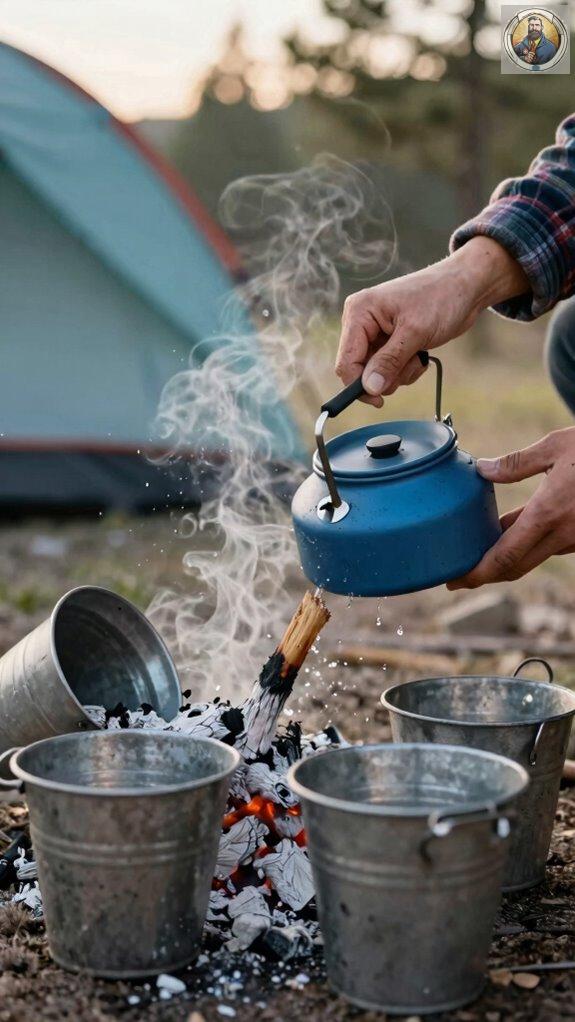
Put that fire out like a champ, not a campfire-killer (looking at you, overzealous dad with half a lake). I learned after Emily said my “smoldering masterpiece” smelled like burnt socks. Nope.
- Drown it with water—lots. Think “I brought three buckets, yes I’m that guy.”
- Stir the ashes like you’re cooking scrambled eggs at 6 a.m. (because someone always wakes up hungry).
- Check for heat with the back of your hand—don’t be brave. No fireproof gear helps if you’re nursing a burn.
- Repeat until it’s cooler than Sarah’s “we’re leaving now” voice.
- Do this every time That’s not paranoia—that’s emergency preparedness, buddy.
- If someone gets burned despite your precautions, a survival signal mirror can help attract rescue attention while you seek medical help.
Cold fire = safe sleep. And maybe fewer lectures from the wife.
Teach Kids How to Make a Fire Cold Out
– Start small—Use a mini fire in your fire ring, nothing crazy (think “warm-up s’mores flame,” not “bonfire beast mode”).
Let’s be real—Emily once tried to “extinguish” a fire with lemonade.
(Spoiler: It didn’t work. And no, we don’t recommend sticky citrus as firefighting gear.)
Teaching kids to make a fire cold out isn’t just smart—it’s campfire legends material.
“The Dad Who Actually Checked for Heat” has a nice ring, right?
Here’s how we play it: Turn cold-out time into fire safety games.
Liam races me to fully douse, stir, and check.
Winner gets bragging rights (and first pick of marshmallows).
Use water, stir with a stick (burnt end = free poker), then *hover* your hand *over* the ashes—no touching!
Cold = safe.
Steam? Keep going.
When teaching fire extinguishing, incorporate Leave No Trace principles to ensure kids understand the environmental impact of their actions and develop responsible outdoor habits.
Pro tip: Do this at dusk.
It feels dramatically important.
(Also, Sarah says I’m *finally* using my Boy Scout training for good.)
Teaching Fire Safety Together
When we’re all gathered around the firepit, jackets zipped to our chins and toes pointed toward the flames, that’s when I know it’s time to level up the fire safety talk—not with a lecture, but with a *moment*.
- Never toss random trash into the flames—yes, Liam, that includes plastic dinosaurs.
- “It’s fine if it’s small” is one of the dumbest fire safety myths out there.
- Always assign a fire watcher (spoiler: it’s not just my job, Sarah).
- Teach kids real outdoor fire etiquette—like not roasting marshmallows with dad’s favorite hiking stick.
- Consider pairing your fire safety lessons with martial arts games to help kids internalize safety reflexes and awareness around the firepit.
- Pack ultralight dry bags to keep emergency supplies accessible in case of unexpected situations near the campfire.
And no, Emily, blowing on the fire like a birthday cake doesn’t help.
We laugh, we learn, we avoid turning our backyard into a cautionary tale.
Fire safety isn’t scary—it’s family time with fewer 911 calls.
Purchase Abc-Rated Fire Extinguishers
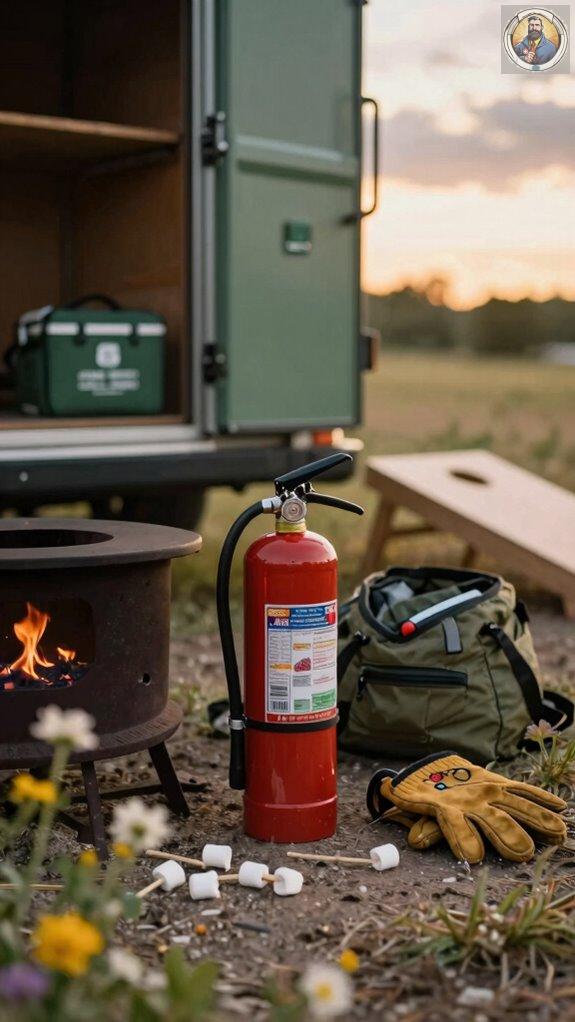
That’s why ABC-rated extinguishers are non-negotiable. Seriously, don’t be that dad who brings a kitchen grease extinguisher to a wood fire like I did in 2018—Liam still brings it up, and Emily won’t let me roast marshmallows unsupervised.
ABC-rated extinguishers are non-negotiable—don’t be the dad who fights a wood fire with a grease extinguisher like I did in 2018.
ABC-rated means it handles wood (A), flammable liquids (B), *and* electrical fires (C)—basically, all the ways modern campfires go rogue. Fire extinguisher selection isn’t the time to thrift or guess.
Look for 5-lb. models; lighter ones quit too fast. Mount it within 30 feet of your fire pit—safety equipment essentials should be grab-ready, not buried under the cornhole set.
Sarah keeps ours in the utility trailer with the first-aid kit.
Pro tip: Test it *before* you need it (yes, even if that means a tiny spray in an empty field). Wouldn’t you rather feel stupid in daylight than helpless at night?
FAQ
Can I Use Gasoline to Start a Campfire?
Stick to safe Choosing Firestarters:
- Wax lint cubes (yes, Liam’s idea—genius)
- Dryer lint + duct tape balls (Emily’s science project)
- Commercial fire sticks
Always pack Fire Safety Gear: shovel, bucket, and a “just-in-case” fire extinguisher.
Trust me—your eyebrows will thank you.
Are Fireworks Safe to Use Near a Campfire?
Nope, fireworks near a campfire? *Bad* combo—like ketchup on ice cream. Firework safety 101: keep them far from flames. I learned after Liam nearly launched a sparkler into our blaze—Sarah still roasts me.
Campfire proximity = disaster waiting to happen. 20-foot rule, minimum. Use a bucket of water and a shovel nearby. And please, no roman candles near marshmallow sticks.
You’re not a wizard, buddy. Stay safe. Stay spark-free.
What Should I Do if My Tent Catches Fire?
I yell, “Tent emergency!” and bail out fast—no time for socks.
Fire containment starts NOW: I kick dirt on flames, not water (learned that from Liam’s melted flashlight).
Seriously, you keep a shovel nearby, right? Right.
Evacuate people first, gear second—if my marshmallow stick burns, so be it.
Once, Sarah threw coffee on a blaze. Spoiler: it helped.
Stay low, stay loud, stay alive.
Is It Safe to Cook Directly Over an Open Flame?
Yeah, I cook over open flames all the time—just not my face. *Campfire cooking*? Totally doable, but Open flame safety’s no joke.
I once incinerated a hot dog so charred, Liam swore it was a hockey puck. Use grills or sticks, keep water handy, and never, ever leave it unattended.
Emily still mocks my “fire-toasted” marshmallows. Trust me—control the flame, not the other way around. Stay smart. Stay fed.
Can I Leave Ashes in a Plastic Bag?
No way, José—nix the plastic bag for ashes! I learned the hard way when I ghosted cool coals in a grocery bag… *boom*, mini bonfire in the garage. Hot embers? Still alive. Still dangerous.
Ash disposal ain’t optional homework. Let ashes cool *fully*—like, 48 hours cool. Then, dump ‘em in a metal can, not plastic. Fire hazard? Absolutely.
Don’t be *that* dad—the one with a melted driveway and a guilty look.


