

5 Essential Dry Bags for Modern Outdoor Dads
Five Essential Dry Bags for Modern Dads
Soggy socks? No thanks. I’ve learned the hard way that one dry bag simply won’t cut it.
This is why I write for Modern Dads. Sharing my chaotic yet hilarious adventures helps fellow dads know which gear really stands up to family fun.
I’ve got a 10L roll-top (bright yellow—my kid’s fave) for messy art days and a 30L eVent backpack that handles every school downpour. Then there are 1L sacks for toothpaste disasters, heavy-duty 210D bags for river trips, and 5L ultralights clipped to my belt for waterproof maps. Trust me, you need gear that survives muddy paws and leftover snacks.
Last summer, we made a day trip to the lake. I packed all my trusty dry bags. We had fun splashing around until my little one “helped” unpack the snacks into the waterproof bag. At least we had dry socks to change into!
Quick Takeaways
- Choose 10L roll-top dry bags in bright colors for visibility and reliable water protection during outdoor adventures.
- Opt for 30L waterproof backpacks made from durable ripstop nylon to withstand heavy use and rainy conditions.
- Use 1L dry sacks to keep toiletries, snacks, and hand sanitizer dry and organized in any weather.
- Pack heavy-duty dry bags with roll-top seals for safeguarding gear during river crossings and prolonged camping trips.
- Carry lightweight 5-10L dry bags for kids’ essentials and pair with waterproof maps to teach outdoor navigation.
Dry Bags for Kids: What Size and Type You Need
When you’re knee-deep in planning a family camping trip and suddenly recall your 8-year-old dumped a juice box in the back of the car last weekend, you realize—yeah, your kid needs a dry bag, and not just any glorified ziplock.
Think stormproof gear that laughs at puddles and splash wars. You want waterproof electronics safe, right? Liam once dropped his tablet in a creek—RIP, Netflix.
Get a 10L roll-top dry bag (think: Sea to Summit). Bright colors = no lost bags. Bonus: attach a carabiner to your backpack.
Seriously, would you store marshmallows in wet socks? Exactly.
For writing supplies during wet weather adventures, consider pairing your dry bag with all-weather pens for kids so your child can journal or sketch without worrying about water damage.
Problem solved. Dad win.
Top Dry Backpacks for School and Day Trips
Because I’ve bailed out waterlogged textbooks more times than I care to admit—thanks, Liam, for leaving your backpack in the rain during that “quick” soccer practice—I now live by one rule: if it’s not in a dry backpack, it’s already soaked.
One soaked backpack, one ruined textbook, one lesson burned into my soul—store it dry or admit it’s already a goner.
Need a pack that laughs at puddles? Try the 30L Sea to Summit eVent—light, bombproof, and big enough for day hikes or school chaos.
For outdoor adventure planning, I always stash a spare in the trunk. And hey, waterproof gear maintenance isn’t magic: rinse zippers, dry seals, don’t toss it under bike helmets (learned that from Sarah’s glare). Consider pairing your dry bag with a survival bracelet to ensure your kids have emergency preparedness tools on hand during outdoor outings.
Pro tip: Label your kid’s pack—Emily still denies she “borrowed” mine for art class. Spoiler: glue stains don’t wash off dry bags. Why do you think they call it *dry*?
Small Dry Sacks for Toiletries and Snacks
Even if you think tossing toiletries into a Ziploc is “good enough,” trust me—your toothbrush will feel different after floating in a puddle at the bottom of your hiking pack.
- Keep toothpaste *and* your dignity with 1-liter dry sacks—they laugh at leaks.
- Snacks stay crunchy, not soggy, because nobody wants trail mix soup.
- Slide a hydration bladder into one for emergency preparedness—yes, even dads forget water sometimes.
- Toss in hand sanitizer, because Liam *will* eat a granola bar after petting a goat.
Small dry sacks? Non-negotiable. They’re the unsung heroes between you and mild wilderness regret.
Plus, they scream “I’ve got this!”—even when you don’t.
For younger adventurers, pairing dry bags with lightweight daypacks ensures your toddler stays comfortable during longer outdoor excursions without the extra burden of heavy gear.
Heavy-Duty Dry Bags for Hiking and Camping
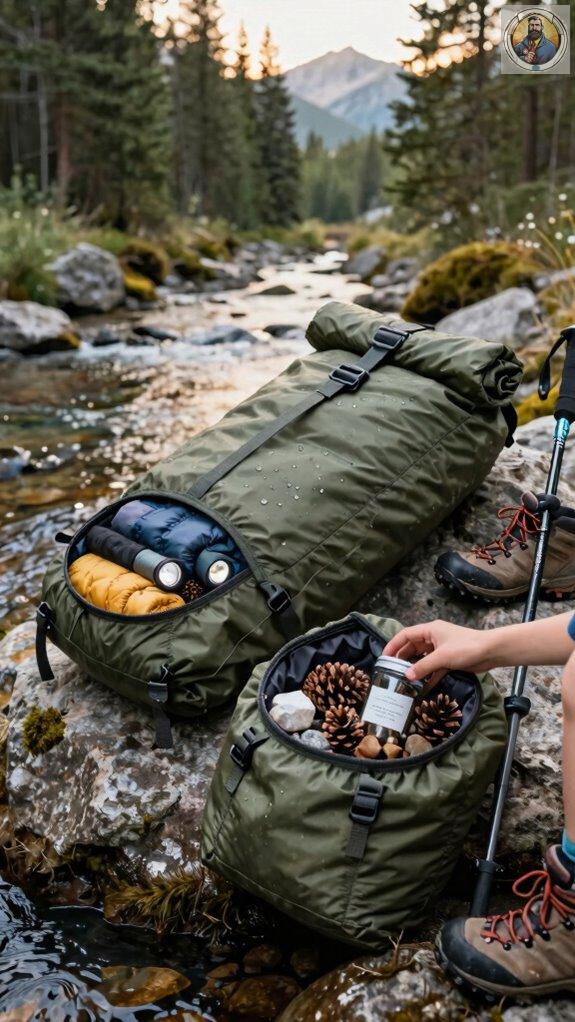
– 100D or 210D ripstop nylon? Worth every penny.
When your tent *and* pride are stuffed inside, material durability isn’t optional.
I learned after my cheap bag burst near Lake Tahoe—cue soggy socks and Liam’s snack stash floating downstream.
Heavy-duty dry bags laugh at downpours, river crossings, and Sarah’s “Why’d you pack *that*?” looks.
Key secret? Sealing technology.
Roll-top closures: three tight folds, then clip shut.
No hocus-pocus—just dry sleeping bags, every. Single. Time.
Brands like Sea to Summit and drypak? Trusted. Tough. Not fashion-forward, but hey, neither am I after 10 miles.
For kids joining outdoor adventures, specimen collection jars offer a practical way to keep small discoveries dry and organized during hikes.
Want survival-grade dryness? Invest.
Your gear (and dignity) will thank you.
Lightweight Kids’ Dry Bags for Young Hikers
Size matters: 5 to 10 liters is ideal—fits snacks, a light fleece, and that weird rock they refuse to leave behind.
Size matters—5 to 10 liters fits snacks, a fleece, and the weird rock they’ll never let go of.
- Pick lightweight camping gear—my son Liam once ditched his bag because it “felt like a backpack full of bricks.”
- Trust waterproof technology—because soggy peanut butter sandwiches make tiny hikers cry. (Ask me how I know.)
- Bright colors = fewer lost bags—Emily’s neon pink one survived three creek crossings and a squirrel interrogation.
- Roll-top seals beat zippers—they’re simpler, tougher, and less likely to jam when your kid’s “helping.”
Seriously, would you carry a grown-up’s dry bag? Neither will they.
Teaching Map Navigation Together
While you’re out there lugging the heavy pack and pretending you enjoy “rustic camping,” let me tell you—teaching your kid to read a real paper map is one of the sneakiest bonding experiences you’ll ever have.
Remember when Liam thought a blue squiggle meant “dragon territory”? Nope—just a creek. We laughed, then nailed down chart symbols: blue = water, black = man-made, green = “yes, Emily, that’s where the bugs live.”
I hand him the compass. “You navigate.”
His first route? A scenic tour to a bush he swore was a grizzly.
Worth it.
You’re not just teaching navigation skills—you’re building confidence, one hilarious wrong turn at a time. Selecting a waterproof trail map ensures your paper guide survives unexpected splashes and weather changes during the adventure.
Spoiler: we’re all lost.
Just not helplessly.
Purchase Ultralight Dry Bags
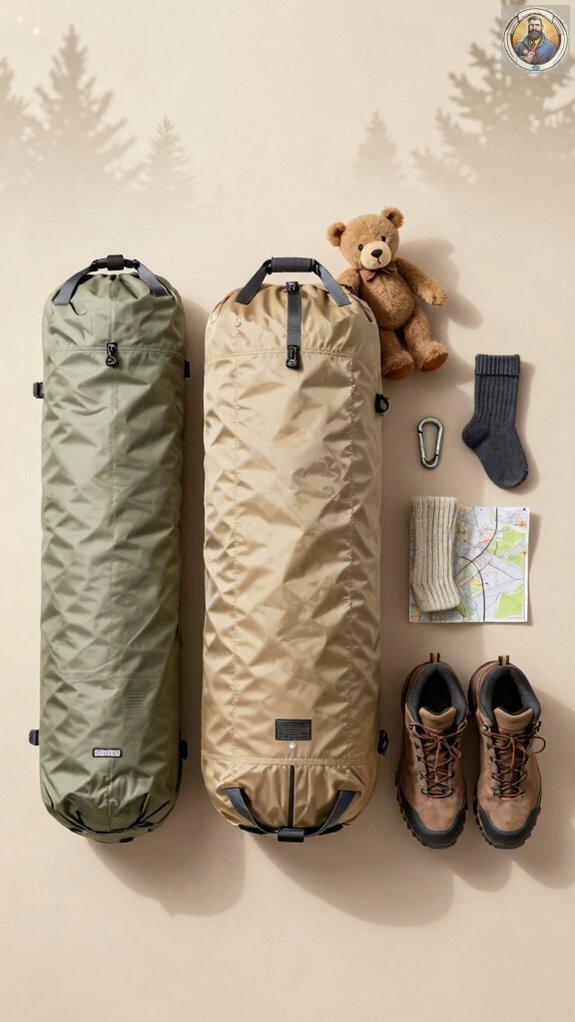
I’m telling you, one soak in a leaky backpack and suddenly your spare socks are hosting an aquatic life form. Not cool, especially when Liam’s snack stash turns into soup. Here’s how I avoided that mess:
- Prioritize material durability—300D ripstop nylon laughs at river rocks.
- Stick with solid brand reputation—think Sea to Summit, not “mystery bag from outlet bin.”
- Keep it ultralight—under 4 oz means more room for jerky.
- Double-check seals—because Emily’s stuffed bear *does not* float.
Sarah still laughs at my “dry bag obsession,” but hey—who had dry phone, dry kids, and zero amphibians in their underwear? Yep.
FAQ
Can Dry Bags Be Used for Air Travel?
Yep, I totally stash dry bags in my carry-on—perfect travel essentials! They’re legit packing solutions, especially when I’m tossing clothes in or keeping snacks dry (because yes, I tried bringing Goldfish through TSA—don’t ask).
I crush packing with 20L SealLine models. Roll-top? Genius. Squeezes out air like my toddler’s floaties.
TSA side-eyed me once, but hey—organized socks win every time. Just don’t label them “explosives.” (Liam did. Long story.)
Are Dry Bags Eco-Friendly and Recyclable?
Yeah, some dry bags are eco-friendly and recyclable—shocking, right? I grabbed a few made with eco friendly materials like recycled TPU and PVC-free linings. Surprise! They don’t all leach plastic like my kids’ bath toys.
Look for brands like Sea to Summit or Ortlieb with a recyclable design. I actually *didn’t* toss ours into the void—Sarah high-fived me.
Check the label. Recycle it like you *mean* it—unlike Liam’s “art” projects. Don’t lie.
How Do I Clean and Maintain a Dry Bag?
I hand-wash mine with mild soap and lukewarm water—no dishwasher dramas, unlike that one time Liam tried to “help” and melted his lunchbox.
For Cleaning methods, I use a soft sponge; no scrubbing like I’m sanding a deck!
Air-dry it open, or it’ll smell like wet dog + regret.
Maintenance tips? Don’t overpack—it’s not a suitcase, Sarah! Re-seal strips yearly.
Works great for kayaking, hiking, even hiding snacks from Emily.
Do Dry Bags Float When Dropped in Water?
Yeah, most dry bags float—thanks to trapped air and lightweight materials.
I’ve dropped mine in rapids twice (oops, Liam, I *told* you not to stand up in the kayak).
Brands like Sea to Summit and NRS use ripstop nylon with welded seams—top-tier waterproof technology.
Material durability? Off the charts. They won’t pop like a beach ball, but don’t toss them like confetti.
Pro tip: never overstuff. Float test yours *before* trusting it mid-river. Duh.
Can I Personalize Dry Bags With Names or Labels?
Yep, you can totally personalize dry bags—heck yes! *Personalization options* mean I slapped “Liam’s Gear (aka Chaos in a Bag)” on one with a waterproof marker.
*Custom labels*? I used duct tape and Sharpie—worked for three whitewater rapids and one curious raccoon. Want laughs *and* function? Write funny names. “Sarah’s Sanity Kit” floats—and so will your ego.
Pro tip: Test ink first. My “Emily the Explorer” bag survived mud, but not my spelling.


