

5 Tarp Shelter Tips for Modern Adventure Dads
Quick Tarp Tips for Adventure Dads
Nothing beats the chaos of setting up a tarp while my kids tumble around like clumsy penguins.
I write for Modern Dads to share real-life lessons—like how I swapped my bulky tent for a lightweight 8×10’ silnylon tarp. It’s a game changer.
A 24” entrance? Perfect for solo kid entries.
I anchor corners using random sticks or my buddy’s hiking chair. Knot tying? We made it a marshmallow wrestling contest.
Finally, setup is a 5-minute race; winner picks the hot cocoa flavor. It’s all about fun and laughter—less stress for Dad!
One time, while battling wind during our camp-out, I watched a kid get tangled in tarp lines. We laughed so hard, we nearly spilled hot cocoa everywhere! Moments like these remind me why I love being a dad on outdoor adventures.
Quick Takeaways
- Choose an 8×10-foot silnylon or Dyneema tarp for lightweight, durable, weather-resistant family shelter.
- Design low, wide entrances (24–36 inches) so kids can enter easily and safely unassisted.
- Anchor corners securely with stakes, rocks, or natural features and use jam sticks for added wind stability.
- Turn setup into a 5-minute family game with assigned roles to build teamwork and outdoor confidence.
- Switch to ultralight gear to reduce pack weight, speed up setup, and simplify family camping adventures.
Choose the Right Tarp Size for Kids
Why do so many dads end up wrestling with a tarp that’s either way too small or ridiculously huge when the rain starts?
Because no one warns you that most tarps are either postage-stamp tiny or require a forklift
Spoiler: it’s not just bad luck. I once bought a “family-sized” tarp that barely covered Emily’s scooter. Rookie move.
Here’s the fix:
- Aim for 8×10 feet—big enough for Liam, Sarah, and my questionable snack stash.
- Lightweight tarp material like silnylon cuts weight without sacrificing strength.
- Bright tarp color? Yes, please. That neon green one doubles as a “hey kids, gather here” beacon.
Ever tried sheltering three kids and a soggy Lab under a picnic blanket? I have. Never again.
Pick the right size, and you’re not just staying dry—you’re winning dad points.
Trust me, they notice.
Mostly when Dad doesn’t panic at the first raindrop.
Set Up a Low Entrance Kids Can Use Alone
Even if you’re the type of dad who thinks “tarp = instant roof,” skip this part and you’ll end up playing doorman every five minutes when the kids need to duck in from the rain—been there, held the flap, got the muddy knee.
Accessibility design isn’t just for fancy buildings—kids’ shelters need it too. A low, wide opening means Liam (5) and Emily (7) can scramble in solo. No more trapped thumbs or face-plants in puddles. Child safety? Check. Independence? Double check. Proper youth hydration bladders should also be accessible near the shelter entrance so kids can stay hydrated during outdoor adventures without needing adult assistance. Consider attaching a kid-friendly tool lanyard to a stake near the entrance so children can access basic tools independently in case of minor shelter adjustments.
| Height | Works For |
|---|---|
| 24″ | Toddlers (and grumpy dads in rain) |
| 30″ | Most kids (ages 3–8) |
| 36″ | Taller kids + gear hauls |
| 48″+ | Easier for YOU, but forget kid access |
Keep it under 30 inches. Seriously, do it. Your back (and pride) will thank you when Sarah isn’t laughing at you holding the flap… again.
Anchor the Tarp With Sticks, Rocks, or Chairs
When the wind kicks up and your tarp starts doing the cha-cha across the campsite—yep, same one where Liam spilled half a water bottle trying to “help”—you’ll wish you’d spent five minutes anchoring it right.
Forget fancy stakes every time. I use sticks (sturdy ones, not twigs that scream “I give up”), flat rocks on corners, or even a camp chair holding a corner down—Sarah laughed till it worked.
Smart tarp material selection means lighter tarps fly away easier, so anchor like you mean it. Camping safety isn’t just bears and bugs—flying tarps = ninja hazards. For younger adventurers who want to inspect your setup more closely, pocket magnifying glasses can help them see how tightly your knots are tied and how securely your anchors hold. Using biodegradable materials for your camping gear helps protect the natural environment where you’re setting up camp.
Try this:
- Tie corners to saplings (if available).
- Weight rocks on guylines.
- Jam sticks through grommets, angle them into the ground.
Pro tip: If your tarp flaps like a panic attack, it’s under-anchored.
Now go beat the wind. Again.
Teach Kids These 2 Must-Know Tying Knots
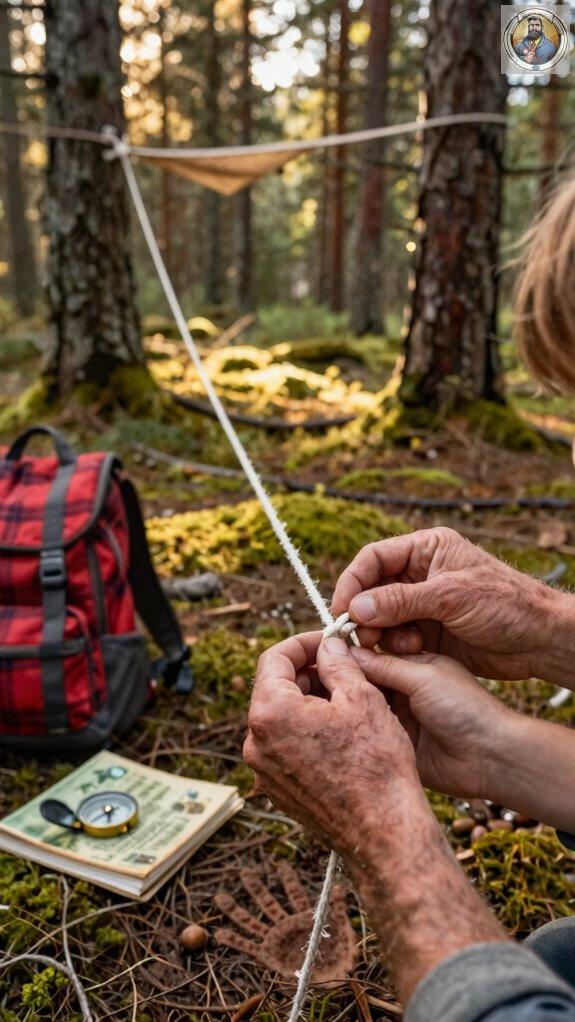
If your kid can’t tie a knot, they’re one squirrel away from losing the whole shelter. I learned this when Liam tried to “secure” our tarp with a granny knot—it lasted 37 seconds. Not cool when rain is coming and you’re worried about weather considerations like, I don’t know, *not drowning*.
Teach ’em two: the taut-line hitch (adjustable, genius for tension) and the bowline (unshakable, like Sarah’s coffee addiction). When setting up camp, having safe removal tools on hand is equally important for handling any ticks your kids might pick up outdoors. Teaching proper leave no trace principles ensures your campsite stays pristine for future adventurers.
- Taut-line: Wrap rope around pole, loop back through itself, twist three times—done. Perfect when wind or animals try to sabotage you (looking at you, raccoon mafia).
- Bowline: Make a bunny hole, rabbit comes up, around the tree, back down the hole. Boom—animal safety secured.
Seriously, these knots saved our butts during the Great Squirrel Siege of ’22. Your kid ties one? Instant hero.
Make Tarp Setup a 5-Minute Nightly Game
Because I used to spend half the night wrestling with a flapping tarp while Liam laughed and Emily “helped” by holding one corner like a sad flag, I turned setup into a 5-minute game—and now we nail it every time.
Want quiet camp privacy *and* your sanity? Master quick deployment strategies. We race: beat the clock, not each other. I shout, “Go!” and boom—tarp, poles, guylines fly.
Emily stakes the foot end (yes, she *finally* stopped folding the tarp in half), Liam whips up the A-frame, Sarah pretends she’s not impressed (she is). Making sure kids wear kids safety vests during setup keeps everyone visible and protected in the campsite.
Rules:
- One try. No redo unless bears interfere.
- Use only our $20 REI tarp (no cheating with ultralight magic).
- Winner picks breakfast (loser cooks).
We’re down to 4:18 once. Cold, dry, and smug? Yes. Feels better than Wi-Fi at a campground. Since we’re hiking in bear country, we also make sure everyone carries bear bells to stay safe on the trail before we even set up camp.
Try it. You’ve got nothing to lose but soggy socks.
Teaching Knots Together
Spoiler: there’s no “bunny knot” in survival manuals. Liam tried teaching his stuffed bear last trip—adorable, but zero stars for knot safety. Instead, I teach real tying techniques the fun way: “If it slips, you’re sleeping in a puddle—no second chances.” We practice the taut-line hitch every time we set up. It’s like Velcro for paracord—adjustable and tough. I tie one; he copies.
Emily laughs until she actually nails it. Pro tip: compete for fastest knot (loser does dishes). Tying techniques matter—especially when 30 mph wind tests your handiwork. Once, my “quick” bowline failed mid-storm. Beyond knots, martial arts games can teach kids the same discipline and focus needed for survival skills through engaging, physical practice at home. These shared adventures in outdoor competency become formative moments in developing masculine identity as boys learn resilience and self-reliance through practical challenges.
Lesson? Double-check *everything*. Knot safety isn’t just smart—it’s dad-level stupid *not* to. So grab some rope. Try a taut-line, then a bowline. Ask yourself: “Would this hold if Sarah pushed it?” Probably not. Practice more.
Grab Ultralight Tarps Now
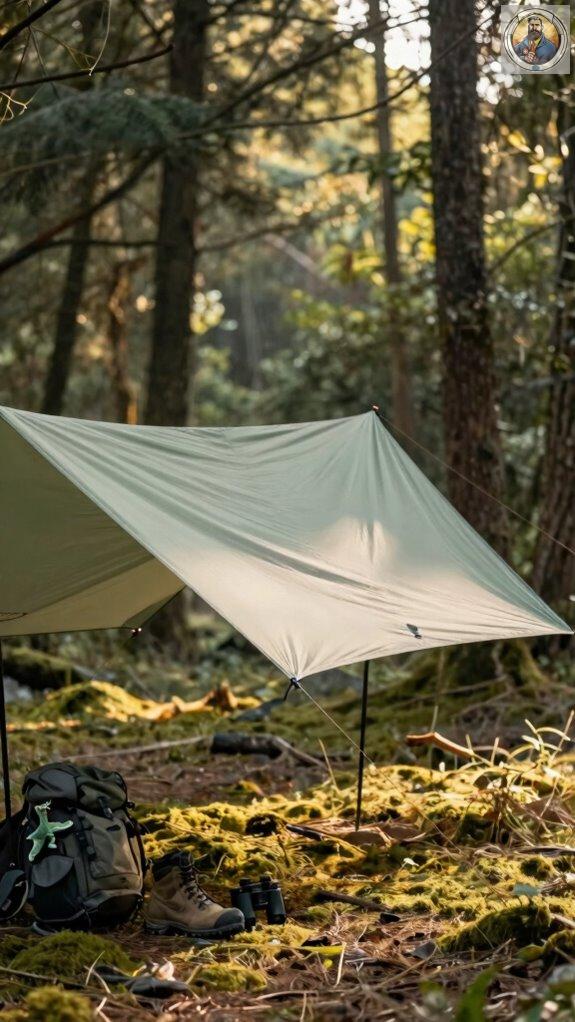
One pound. That’s how light my tarp is—lighter than Liam’s idea of “packing light” (he brought three toy dinosaurs on our last hike).
If you’re still lugging that bulky tent, stop. Ultralight tarps are game-changers. With smart tarp material options like Dyneema and silnylon, you get durability without the drama.
Plus, modern weather resistant features? Rain tried to ruin our campout—*it failed*. For family adventures, keeping binoculars and other compact youth binoculars handy enhances outdoor exploration during your camping trips.
For family adventures, lightweight camping tarps have become essential gear that combine portability with reliable shelter.
Here’s why you need one:
- Weighs less than guilt after eating all the gorp
- Sets up faster than Emily claims she can clean her room
- Saves space like Sarah’s “one suitcase” vacation hack
- Looks cool—yes, shelter can be stylish
Stop overpacking. Start outsmarting. Grab ultralight tarps now—your back (and kids) will thank you.
FAQ
Can I Use a Tarp in Heavy Rain With Kids?
Yeah, you *can* use a tarp in heavy rain with kids—but only if you’ve practiced setup, sealed the seams, and packed a repair kit.
Last time, Liam crawled under a saggy tarp while Emily yelled, “Dad, it’s raining *inside*!” Now I always check for Tarp maintenance issues pre-trip.
Emergency repair? Duct tape and tenacity. Pitch it tight. Angled. Guy lines secured.
Trust me—Sarah won’t tolerate soggy marshmallows. Again.
How Do I Keep Bugs Out Under a Tarp?
I keep bugs out under a tarp using insect barriers—because no one wants to play “swat the mosquito” at 2 a.m.
Once, Liam woke up screaming—a spider? Nope. Just sweat tricking a 6-year-old.
Try netting options like a bug bivy or tarp with built-in mesh.
Set up a perimeter! Tuck edges under pads. Bring a headnet.
Want comfort? Use a freestanding net shelter under your tarp—game changer.
Why suffer? Sleep like a dad who plans.
Is a Tarp Safe in Windy Conditions?
Yes, a tarp’s safe in wind—if you don’t *want* it becoming a runaway kite. I learned this when Liam’s stuffed bear flew 200 yards.
Choose ripstop nylon or polycotton—durable stuff. Pitch low, use guylines, and angle the tarp like a ninja crouch.
Stake every corner. Double guylines? Yes.
Me? I once skipped it. Sarah hasn’t let me forget how we ate dinner under a flapping sail.
What’s the Best Tarp Color for Visibility?
Orange—bright, obnoxious orange—is my go-to for tarp color visibility. You wanna be seen, right? Like, *really* seen?
Tarp color safety isn’t just smart, it’s how Sarah stops me from “blending into the woods like a sad mushroom.” I once lost Liam’s red jacket in 3 inches of fog—never again.
Go bold: orange, yellow, or hot pink. Your future rescuers—and Emily when she’s hiding snacks—will thank you.
Can Toddlers Help Pitch a Tarp Safely?
Yeah, toddlers can help pitch a tarp—*safely*—if I’m right there, hands-on. Think: “Hold this corner, sweetie!” not “Here’s a mallet, go nuts.”
With Liam at 3, I let him tuck edges under rocks—supervised, of course. Parent supervision isn’t optional. We call it “Emily’s Tarp Time” when she “secures” one foot of guyline. Spoiler: It takes longer. But hey, mud pies count as survival skills, right?


