

7 Essential Fire Suppressan Tips for Modern Safety Dads
Fire Safety Gear: What Every Dad Needs
Think one fire extinguisher is enough? I used to believe that until a flaming marshmallow incident almost burnt our s’mores stash. Now, I’ve got seven essentials for safety: an ABC extinguisher by the grill, fire spray for kitchen messes, a fire blanket in the tent, flame-resistant jackets for the kids, smoke alarms in the camper, glow sticks for emergencies, and a water mist extinguisher for charcoal.
I even test these out monthly, rain or shine. Spoiler alert: surprise drills are the secret sauce—last one had us out in 8 seconds flat. It’s not just the gear; it’s being ready before things heat up.
Not long ago, while camping, I turned my back for a second. Suddenly, my little one had a marshmallow-ingesting showdown with a stick. Just another day where fire safety wasn’t just gear—it was pure dad instinct!
Quick Takeaways
- Choose ABC-rated fire extinguishers for versatile protection against common campfires, grease, and electrical blazes.
- Mount fire extinguishers within 3 seconds’ reach of cooking areas and check them monthly for expiration or damage.
- Use fire blankets in tents for smothering small flames, especially near sleeping zones with children.
- Pack pressurized fire sprays with reliable nozzles to quickly suppress stove or grill flare-ups.
- Install battery-powered smoke alarms near sleeping areas and test them monthly for continuous detection.
Choose the Right Fire Extinguisher for Your Campsite
Choose a Class B:C or ABC extinguisher—these handle flammable liquids (like propane), electrical fires, and yes, wood or charcoal fires. Trust me—your s’mores shouldn’t end in a 911 call.
Look, I thought a kitchen extinguisher would do. Spoiler: it didn’t. When Liam knocked over the camp stove, I grabbed the wrong one—Class A only? Useless on propane. Now I keep an ABC right by the picnic table.
Thought a kitchen extinguisher would cut it? Nope. Class A on propane—total fail. Now I keep an ABC by the picnic table. Learn from my marshmallow meltdown.
Fire extinguisher types matter like superhero powers:
- ABC = the Swiss Army knife of flames
- BC = great for grills, bad for campfires
- Don’t be “that guy” with a decorative $30 novelty extinguisher
Campsite fire safety isn’t just “hope for the best.” It’s “be ready when your marshmallows declare war.” Effective time management means preparing your safety equipment before emergencies strike, not scrambling in the moment.
Ever seen Sarah panic over a flaming hot dog? (Spoiler: it’s not pretty.) Bottom line: Buy ABC. Mount it. Know the PASS method. Your ego won’t survive explaining to rangers how you let a burrito start a forest fire.
When selecting equipment for your site, remember that minimize impact on soil by keeping fire suppression tools designated and ready rather than scattered throughout your camping area.
Keep a Fire Blanket in Your Tent Zone
Tent fire precautions aren’t just for Boy Scouts—remember when Sarah’s marshmallow caught fire and singed the rainfly? Yeah. Learn from my shame.
- A folded fire blanket fits in a stuff sack the size of a rugby ball—toss it near your sleeping bags.
- Half the weight of an extinguisher, but stops flames dead with zero chemicals.
- Wrap it around small fires like you’re swaddling a flaming baby (don’t try that).
- Secure your fire blanket alongside other essential gear using portable hammock straps to keep emergency equipment organized and easily accessible in your tent zone.
For nighttime visibility during emergencies, pair your fire blanket with emergency glow sticks to help family members locate each other and move safely away from danger. Keep it dry, reachable, and notunder Emily’s stuffed llama.
Safety wins when it’s simple.
Pack Fire Spray for Quick Stove and Grill Fires
Why wait for a grill flare-up to turn into a full-blown campfire fiasco? Trust me, I learned after Liam “accidentally” lit broccoli on fire—again.
Grill flare-up waiting to happen? Don’t learn the hard way—Liam’s flaming broccoli taught me: be ready before the fire jumps.
Pack a fire spray. Not that dinky expired keychain kind. Get a real one with *optimal spray pressure*—you want a focused beam, not a sad mist.
Check it monthly. That’s *fire spray maintenance*, folks. Shake it, test it (away from faces—learned that with Emily). For added home safety, consider keeping waterproof bandages for kids in the same emergency kit for minor burns or injuries.
Store it near the stove, not buried under marshmallows. Just like kids’ sleeping pads need proper storage for longevity, fire suppressants require a dedicated spot that’s easily accessible during emergencies.
Sarah still laughs at my “grill drama,” but last week? Flame jumped two feet high. One blast—*done*.
Look, you wouldn’t hike without bandaids. So why cook without a spray ready?
Keep it charged. Keep it close. And maybe skip the flaming broccoli.
Use Flame-Retardant Clothing for Kids
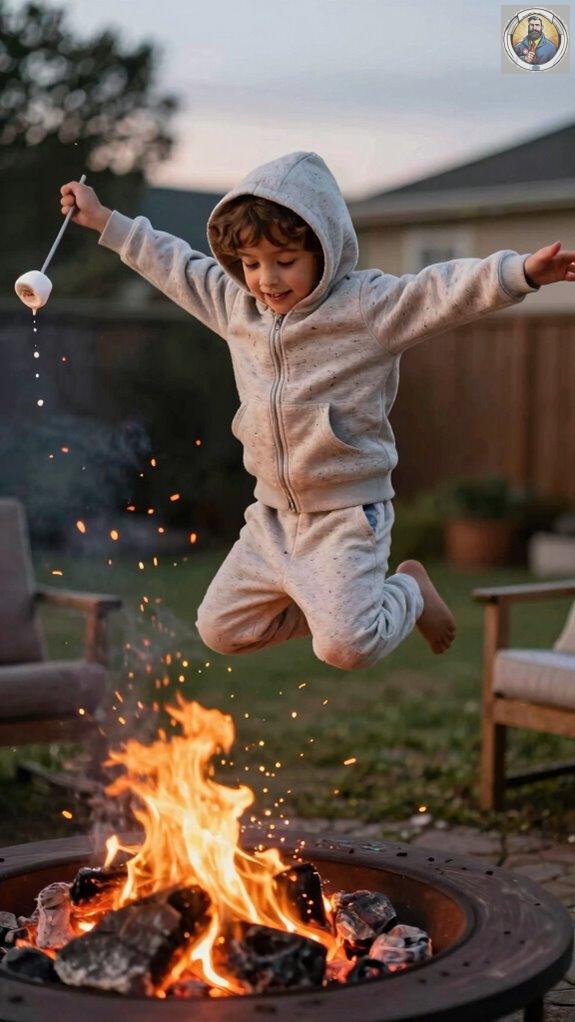
Envision:
- A polyester hoodie melting into a marshmallow on a grill? Nope, thanks.
- Emily doing a daring “lava tile” hop near the fire pit? Flame-resistant jacket = peace of mind.
- Sarah side-eyeing me for letting the kids near flames at all? At least I’m not dressing them in tissue paper.
I didn’t believe it until the s’more incident of ‘22 (long story). Now I check labels like a hawk. Look for CPSC-compliant fabrics—especially for pajamas.
Your fireproof kid mightn’t win a fashion award, but hey, they’ll be around to appreciate it.
Add Smoke Alarms in Campers and Tents
I still recall waking up to Liam’s flashlight beaming in my face because he’d kicked over the propane heater in the camper—thankfully, before anything went wrong, but it was way too close for comfort.
Ever tried sleeping while your kid turns the camper into a potential volcano? Yeah. That’s why I treat fire alarm installation like toothbrushing—non-negotiable.
Here’s the deal:
- Get battery-powered smoke alarms rated for RVs (yes, regular ones whine like a toddler in rain).
- Mount one near the sleeping area—6 inches from the ceiling, not wedged behind Emily’s stuffed llama.
- Pair it with emergency lighting planning: I stash battery lanterns where Sarah won’t trip over them (so, not near her coffee stash).
- Consider keeping spork multi-tools in your emergency kit alongside flashlights for quick access during dark camping situations.
Real talk: If the alarm screams at 2 a.m., you want lights already working.
Would you roast marshmallows blindfolded? Then don’t camp without alarms.
Just do it. Your nap time depends on it.
Run Fire Drills With Kids Before You Camp
– Pick a signal: We use a firm “Fire! Out now!” because “Abandon ship!” confused the kids—and we’re camping, not pirating.
Fire drills aren’t just for schools or Liam’s dramatic “zombie attack” scenarios. Real talk: campfire safety includes knowing how to *leave* the fire, fast. We practice our emergency evacuation planning like it’s a weird family game show. Make sure each family member has a headlamp or flashlight so everyone can safely navigate during an evacuation, especially in low-light conditions. A loud safety whistle can also serve as an effective audible alarm to alert all family members during an emergency.
Picture this:
- Me yelling “Fire!” while Sarah times us like a drill sergeant with a stopwatch
- Emily crawling low like a tiny commando under “smoke” (a.k.a. morning mist)
- Liam “rescuing” the marshmallows like they’re national treasures
It’s goofy, but when shadows get long and the fire crackles a little too loud, I’m glad we practiced. Because fun camping memories don’t include panic, burnt socks, or explaining to rangers why we did not mean to torch the woods.
Bring a Lightweight Water Extinguisher for Emergencies
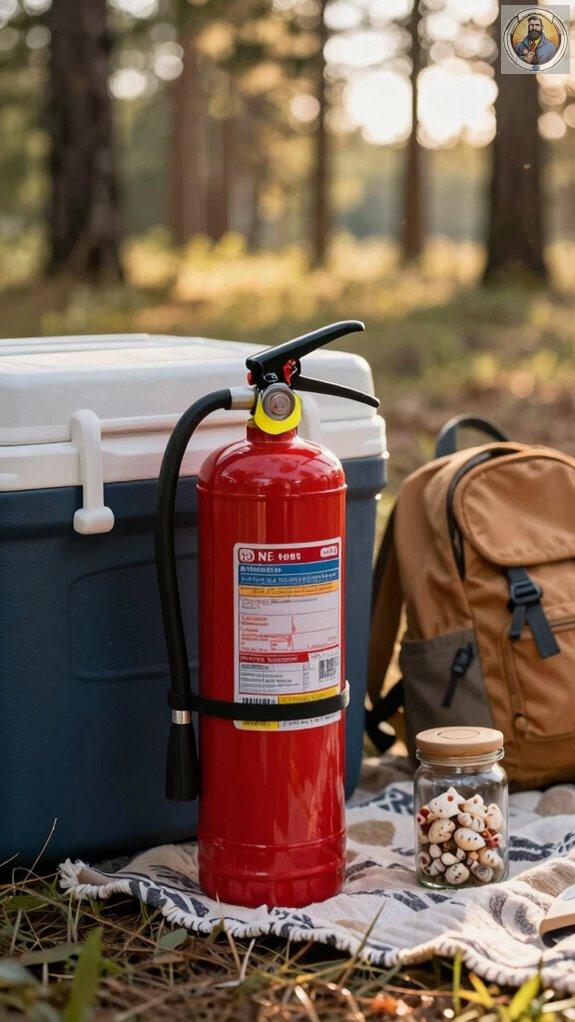
You’ve practiced the drill.
Now envision flames leaping from your camp stove like Liam on TikTok—chaotic and alarming.
That’s when I yank out my 2.5-pound water extinguisher. Seriously, it’s lighter than Emily’s backpack (and just as essential).
Yank out my 2.5-pound water extinguisher—lighter than Emily’s backpack and way more crucial when flames go viral.
Water safety isn’t just for lakes—it’s for flames too. This little hero handles Class A fires (wood, paper, that suspicious marshmallow stash). Just like how specimen collection jars help kids organize and preserve their discoveries, a well-maintained extinguisher keeps your emergency supplies organized and ready.
I keep mine strapped near the cooler, because who wants to wrestle a fire with lukewarm soda? Building a fire safety station near your campsite creates a dedicated space for emergency preparedness.
Fire prevention isn’t optional. Ask Sarah—she still laughs at my “grill incident of ’22.”
- 1A rated extinguisher? Check.
- Hangs within 3 seconds’ reach? Check.
- Refilled annually? Sigh Check.
Don’t be the dad who fights fire with hope. You got this. Mostly.
Teaching Fire Drill Routines
When the smoke alarm screams in the middle of the night, you won’t have time to Google “how to evacuate” — so we practice, even if Liam pretends to be a dramatic news anchor announcing his own fiery demise.
Teaching fire drill routines isn’t just smart—it’s fire safety etiquette gold. We run surprise drills monthly (10 seconds or bust!).
Everyone knows our emergency communication plans: meet at the oak tree, not the mailbox like Emily once insisted. Having a designated meeting spot that’s easily accessible, like a compact outdoor location, ensures the whole family can gather quickly during an evacuation.
- Crawl low like you’re sneaking up on a sleeping cat—smoke rises, dummy.
- Touch doors with the back of your hand—no sizzling skin, thanks.
- Shout your name at the meeting spot so I don’t panic thinking Sarah’s still inside.
Making fire drills engaging through martial arts games keeps the kids focused and motivated during practice runs, turning safety training into family fun.
Spoiler: Last time, Liam “died heroically” saving his video game console. Cute.
Now, let’s try not to die before breakfast.
Purchase Fire-Rated Safety Gear
Half the parents I know think a dusty fire extinguisher from 1997 counts as “being prepared”—spoiler: it doesn’t.
Real emergency preparedness means gear that works *now*, not gear that expired before your kid learned to spell “fire.”
I learned this when Liam knocked over a pan and I slid across the kitchen in socks—thankfully no flames, but yikes.
Invest in fire resistant shoes. Not clown shoes with flames painted on—actual rated ones.
Pair that with a fresh extinguisher (ABC type, people!), smoke detectors on every floor, and thermal gloves.
During any emergency, having signal mirrors for visibility ensures your family can communicate and be located quickly if you need to evacuate.
Sarah calls me “Chief Dad,” but guess what? I’ll take it.
You want to be ready when—*not if*—things get hot. Literally.
Check expiration dates. Test monthly. Teach the crew.
Be the hero who doesn’t just look cool, but stays cool. And shod. Always be shod.
FAQ
Can Fire Extinguishers Expire?
Yeah, fire extinguishers *can* expire—shocking, right? I thought mine was immortal till Sarah found ours dated 2012. Like milk, they don’t last forever.
Check the label: most last 5–15 years.
⚠ Pressure gauge low? Squirt test failed?
Time to replace.
For fire extinguish maintenance, I inspect ours quarterly—Liam even helps (he likes the pin-pulling sound).
Know your types of fire suppressants: ABC powder, CO2, water—each fights different flames.
Don’t wing it—your kitchen’s not a circus.
Are Fire Blankets Reusable After Use?
Nope, I don’t reuse fire blankets—once they’ve touched flames, they’re *done*, like my grill after I tried “flame-searing” marshmallows.
Fire blanket maintenance? Only before use: check for tears, keep it accessible.
After deployment? Toss it. Seriously. That charred, smokey rectangle isn’t impressing anyone.
Fire blanket alternatives? Think powder extinguishers—messy but reusable.
Save the “second life” talk for zombies, not safety gear.
Stay sharp, Dad.
How Often Should I Replace Fire Spray?
I replace my fire spray every 5–7 years—no joke, it’s its *expiration era*. Think of it like milk: smells fine, but one sip? Disaster. I once tested ours after 8 years—pfffft—more fart than firefight.
Check your can’s label; know the fire spray lifespan. Stick to a replacement schedule. Set phone alerts.
Trust me, when flames crash your dinner party, you’ll want power, not propellant. Be the hero. Not the guy waving expired foam. Boom.
Do Flame-Retardant Clothes Need Special Washing?
Yes, flame-retardant clothes *do* need special washing—don’t toss them in like your kid’s pizza-stained hoodie.
I learned after Sarah mocked me for turning Liam’s safety gear into a frayed rag. Follow Washing instructions like a boss:
- Use mild detergent (no fabric softener—seriously, it kills protection)
- Cold water, gentle cycle
- Air dry or low heat
Fabric maintenance isn’t sexy, but neither is flammable fashion. Be smart.
Can Smoke Alarms Work in High Humidity?
For smoke detector maintenance:
- Use humidity-resistant models (look for “high-humidity-rated”)
- Install ≥10 feet from showers or stoves
- Wipe units monthly with a dry cloth
- Test alarms every 30 days—no excuses!
Pro tip: I keep Emily on testing duty.
She loves the siren.


