

5 Signal Mirror Guide Steps for Modern Dads
Signal Mirrors: A Dad’s Guide to Shining Hope
Flashing for help in 110°F Nevada? Absolutely. It works like a charm. First, I aim with my fingers—poke a hole, hit that distant rock. Next, I zigzag the light. Fast wobbles outshine any steady glint in the haze.
Why am I sharing this on Modern Dads? Because if my kids, even Emily, can master it on a hike, so can yours.
Liam thought it was a toy—classic dad moment! I combine the mirror with a flare or whistle, doubling our SOS chaos. Finally, I keep it clean and ready, not buried under granola wrappers. Sarah’s been known to eye-roll over that!
Last summer, we found ourselves lost in the woods. My kid’s anxious face matched my own when I pulled out the mirror. When the sun hit it just right and caught the ranger’s attention, I felt like a hero. These moments remind me how being a dad isn’t just about the big moments—it’s the little things that shine.
Quick Takeaways
- Locate the sun and aim the mirror’s reflection through a finger hole at a distant target for precise signaling.
- Sweep the mirror in zigzags during daylight to increase visibility, especially in hazy or low-visibility conditions.
- Teach kids to use the mirror responsibly, emphasizing it’s a survival tool, not a toy.
- Combine mirror flashes with other SOS methods like flares or satellite phones for faster rescue.
- Keep a dedicated, high-quality signal mirror in your car and pack, always ready and well-maintained.
How to Aim a Signal Mirror for Rescue
When you’re stuck in the woods and your phone’s about as useful as a brick, you’ll wish you’d taken that signal mirror seriously. Trust me—I learned during a “quick” hike with Liam when we got turned around near Bear Creek.
Lost in the woods with a dead phone? That signal mirror might just save your bacon—learned it the hard way with Liam near Bear Creek.
Panicking? A little. Then I recollected: signal reflection isn’t magic, it’s science with sass.
First, find the sun (duh). Hold your mirror and make a tiny hole with your fingers. Aim the *dot* of light at a distant tree or rock. That’s your practice target.
Mirror calibration is just fancy talk for “don’t be lazy.” Tilt and tweak until the beam hits dead-on. If you’re spending extended time outdoors with kids, familiarize yourself with recommended tick removal tools to handle any woodland encounters safely.
Pro tip: Use your other hand to cast a shadow—the sweet spot‘s where the beam zips through your fingers like a laser spy move. For nighttime situations when mirrors aren’t visible, consider keeping emergency glow sticks in your pack as a backup signaling tool.
Saw a plane once? Nailed the signal. They didn’t land, but hey, my ego did.
You’ve got this. Now go shine like the dad you are.
When Sunlight Makes Your Signal Most Visible
Plane overhead? Sweep in zigzags. No sun? You’re just holding a fancy paperweight.
Pro tip: check the sky. Clear? Great. Hazy? Boost your sweep speed. Think of it like texting SOS—but with sunlight. For younger family members learning outdoor skills, compact binoculars can complement your signaling practice by helping spot aircraft at greater distances.
And please, for the love of Emily, don’t aim at drones unless they’re rescuing you. Probably not. Unlike all-weather pens, signal mirrors rely entirely on optimal sunlight conditions to function effectively as emergency signaling devices.
Teach Kids These Emergency Mirror Drills
If your kid thinks a signal mirror’s just a shiny toy for fixing hair mid-hike, we’ve got work to do—because that little piece of reflective plastic? It’s a secret SOS weapon. Teaching mirror drills isn’t just fun—it’s emergency preparedness and one of those quirky parental responsibilities no one warns you about. Recall when Liam tried signaling the dog? Yeah, not helpful. Just like pocket hand warmers, signal mirrors are essential gear that keeps kids safe during outdoor emergencies. Consider pairing your signal mirror training with battery storage organizers to keep backup supplies ready for extended outdoor adventures.
Practice these drills:
| Action | Mistake | Pro Move |
|---|---|---|
| Flashing randomly | Annoying squirrels | Aim at distant vehicles |
| Holding mirror flat | Reflecting dirt | Tilt to catch sun |
| Using indoors | Zero effect | Do it outside, duh |
| Panicking | Dropping mirror | Breathe, then flash |
| Ignoring clouds | Giving up | Use edge of clouds to scatter light |
Be the dad who turns shine into survival.
Combine Signal Mirrors With Other SOS Methods
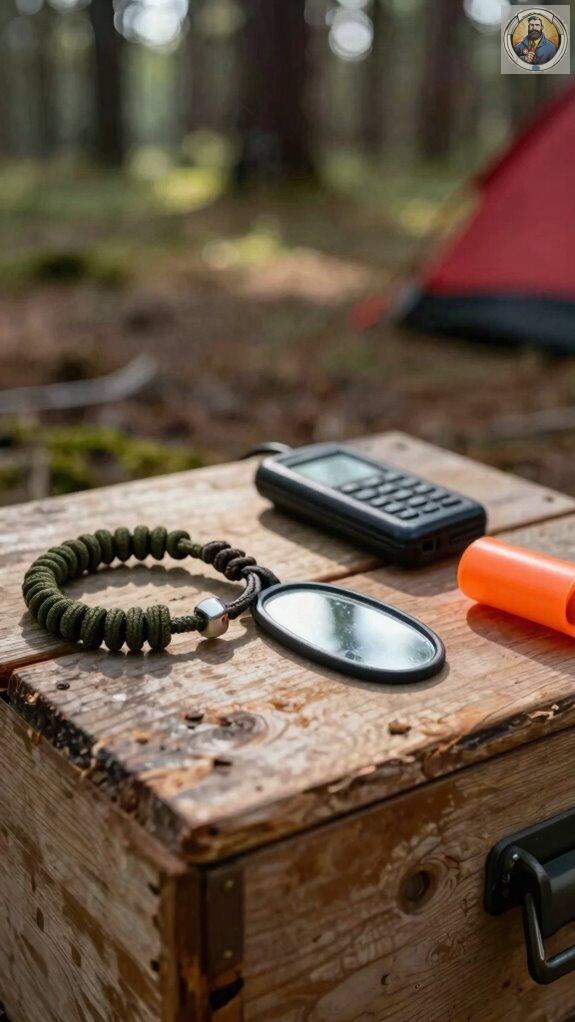
That shiny square isn’t flying solo—nope, your signal mirror packs way more punch when it’s out there *with the squad*. Think of it like a boy band: great solo, unstoppable together.
I learned this when Liam “accidentally” set off a personal flare during a pancake picnic—thanks, buddy, now the whole park’s watching. But hey, if you’re stranded, go full Beyoncé: mirror flashes *plus* that flare equals “HEY, I’M HERE!” energy.
And don’t sleep on satellite phones—they’re like your tech-savvy uncle who always knows the way home. I keep mine clipped to my pack, right next to the mirror. Just like martial arts training, consistency with your emergency gear means you’re always ready when it counts.
Understanding social isolation factors helps explain why emergency preparedness matters so much for modern families. Pro tip: Flash mirror, pop flare, call for help. One method might fail. Together? You’re basically a rescue magnet.
Why Every Outdoor Person Needs a Signal Mirror
Real talk: You don’t need a mirror to look cute in the woods (though, hey, no judgment).
But you do need one when things go sideways. Last summer, I got turned around near Glacier Peak—no cell, flat GPS battery. Panic? Nah. I pulled out my $8 signal mirror. Best. Communication tools. Ever.
Used it to flash a plane 20,000 feet up. Dude, they saw me. SAR team landed 40 minutes later.
Signal mirrors aren’t just for show—they’re lightweight (mine’s 2.5 oz), survive rain, and never need batteries. Unlike Sarah’s Bluetooth speaker (RIP, bear snack playlist). Similar to how nature field guides help kids identify wildlife and terrain features, signal mirrors serve as essential tools for wilderness navigation and emergency communication. For nighttime emergencies when sunlight isn’t available, emergency glow sticks provide an alternative visual signaling method to complement your signal mirror kit.
Wilderness navigation isn’t just maps and compasses. Sometimes, it’s reflecting sunlight like a deranged disco ball to say, “Hey! I’m alive!”
So ask yourself: If Emily were lost, wouldn’t you want Liam to have this tiny, shiny lifesaver?
Carry one. Flash often. Stay found.
Teaching Morse Code Together
Now, flashing “HELP” feels like winning dad-ovation. Who knew survival skills doubled as bonding? Keep your kids warm during extended outdoor practice sessions with pocket hand warmers, which are essential for chilly day signaling adventures. Next time, I’ll skip yelling at drones. Probably.
Purchase Signal Mirror Kits
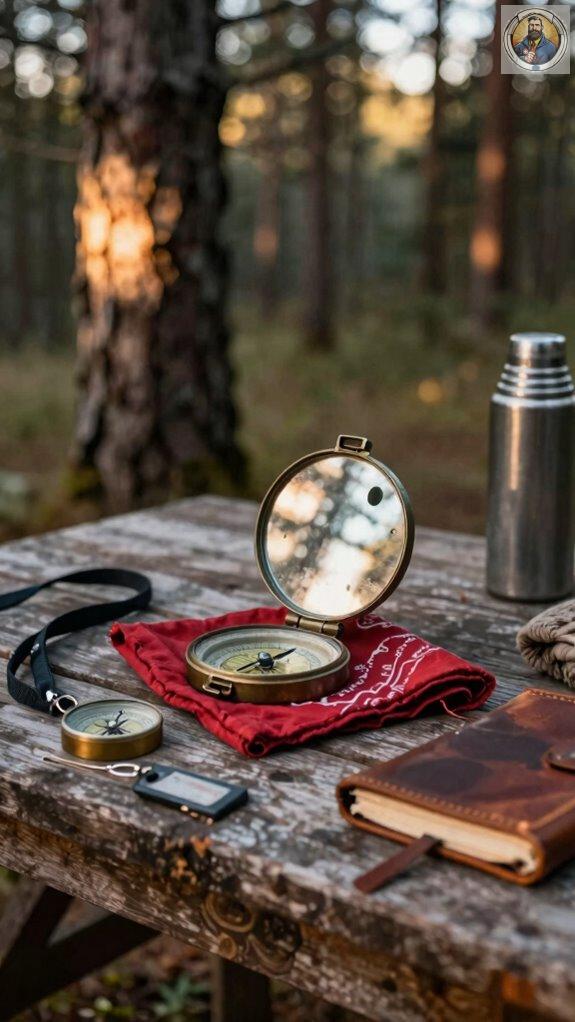
If you’re like me—someone who once used a soup spoon as a “signal mirror” during a camping trip (spoiler: it didn’t work, and yes, Liam laughed for hours)—then it’s time to upgrade to something that actually reflects sunlight like it means business.
Real signal mirrors? Non-negotiable for outdoor safety. I got a $15 kit with a sighting hole and lanyard—way better than my shiny cutlery phase. Look for one with a bright retro-reflective backing so rescuers see your flash even if they’re far off.
Sarah packed ours in the family emergency kit, right next to the whistle and space blankets.
Why bother? Because “emergency preparedness” isn’t just a fancy phrase dads say while pretending to know things. It works.
Pro tip: Buy two—one for the car, one for your pack. Trust me, Emily won’t mock a real mirror. She’ll probably steal it for selfies.
FAQ
Can Signal Mirrors Work on Cloudy Days?
Nope, signal mirrors won’t cut it on cloudy days—wish I’d known that *before* I stood in the drizzle like a hero in a bad movie, waving my mirror at a sky that couldn’t care less.
Cloud cover? It kills reflection. Mirror materials need direct sunlight to bounce signals.
Weather conditions matter *a ton*. Want help? Use smoke, bright fabric, or scream dramatically. (Works about as well.)
Save the mirror for clear skies. Trust me.
Are Signal Mirrors Allowed on Airplanes?
Visual communication tools? Great for wilderness. Annoying for airport scanners.
Pro tip: Wrap it in foam.
Or don’t—watch the agent squint like they’re decoding Morse code.
Emily still teases me about “the great mirror panic of 2023.”
How Far Can a Signal Mirror Be Seen?
“Still waters run deep”—and so does a signal mirror’s reach. I can see ya from up to 10 miles away, buddy, if the sun’s cooperating and my reflection clarity’s on point.
Visual distance? Maxed under clear skies.
Emily once spotted my flash from three driveways over—granted, she was bribed with ice cream.
Aim, don’t stab. Catch light, flash smart.
Works better than Liam’s “invisible laser tag.” Try it!
Do Signal Mirrors Require Batteries to Work?
Nope, my friend—signal mirrors don’t need batteries. Zero. Zilch. Not even a AA for “emotional support.” I love that about them.
Emergency signaling with optical reflection? It’s just sunlight + angle + a little hope.
On that camping trip with Emily and Liam? My flashlight died—shocking, I know—but the mirror still bounced light 10+ miles.
Reflective trust, people! Find shiny surfaces. Practice aiming. Boom—rescue, no charging required.
Who needs power when you’ve got sun and sarcasm?
Can a Regular Mirror Substitute for a Signal Mirror?
Yeah, a regular mirror *can* work, but don’t bet your survival on it. Ever tried signaling with a bathroom mirror? Spoiler: It cracked when Liam dropped it—*twice*.
Signal mirrors survive 10-foot drops (like mine off a cliff—don’t ask), while makeup mirrors? Nope.
Real signal mirrors boost emergency signaling range to 10+ miles. Mine saved my bacon during a hike.
Pro tip: Carry a dedicated one. Your face reflection won’t help planes spot you.


